
How the Geo-HEP Seasonal Storage System Works
Targeted storage
of thermal energy and delivery according to demand.
How the Geo-HEP Seasonal Storage System Works
The Geo-HEP seasonal storage system is being developed as a standalone thermal storage system. Its primary focus is on the targeted storage of heat and cold over extended periods and their delivery according to demand.
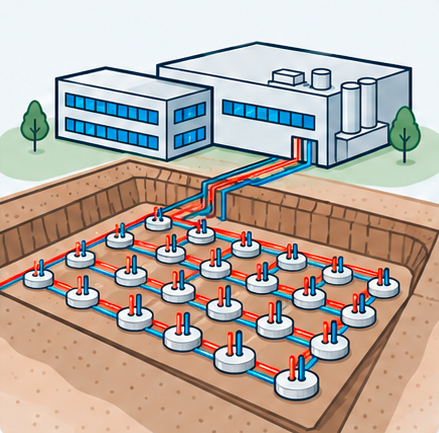
Vertical, water-filled storage units are installed underground and can be connected to form a modular storage array. A stratified charging system is designed to maintain separate temperature levels within the storage unit as much as possible, thereby enabling flexible charging and discharging.
Unlike the Geo-HEP high-performance energy pile, the seasonal storage system does not focus on continuous heat exchange with the surrounding subsurface, but rather on the targeted, long-term storage of thermal energy.
The System Principle
The Principle of Seasonal Storage at a Glance
01
Absorb Thermal Energy
Available heat or cold from buildings, industrial processes, or other suitable sources is fed into the storage system.
02
Store within the appropriate temperature range
The stratified storage system directs thermal energy into the appropriate section of the storage unit based on its temperature level. Warmer sections are located higher up, while cooler sections are located lower down.
03
Maintain temperature stratification
The different temperature zones should remain as separate as possible. Targeted hydraulic loading and unloading supports natural stratification and reduces unnecessary mixing.
04
Reuse as Needed
Heat or cold can be extracted from the appropriate temperature range and made available to a building, a facility, or a technical process. Depending on the system design, the loading and unloading processes can also take place simultaneously.
Thermal Stratification as the Core Storage Principle
The water inside the storage units serves as a thermal storage medium. Depending on the load condition, a temperature profile develops within the storage unit: warmer water tends to be located in the upper part of the storage unit due to its lower density, while cooler water is found in the lower part.
The stratified charging system is designed to support this natural temperature stratification. Inlets and outlets at different heights make it possible to introduce heat or remove cold as much as possible in the storage area whose temperature level is appropriate.
The goal is to limit the mixing of different temperature levels and thereby preserve the usable thermal quality of the stored energy for as long as possible.
Store and Deploy on Demand
Storing Heat or Cold
If thermal energy is available, it can be fed into the seasonal storage system. Heat can come, for example, from summer building cooling, industrial processes, waste heat, or solar thermal energy. Similarly, cold can be stored when it is available at an appropriate time.
The thermal energy is fed into the appropriate storage zone based on its temperature level. Within a storage array, individual modules may have different charge states.
Extracting Heat or Cold
When thermal energy is needed, it can be extracted from the appropriate temperature range of the storage system and made available again for the respective application.
Whether stored heat can be used directly depends on the temperature level of the storage unit and the heat demand of the connected system. If the temperature level is insufficient, a heat pump can raise the available heat to the required level.
Loading and unloading may overlap
The layering principle makes it possible to specifically utilize different temperature levels within the system. Depending on the system's hydraulic design, thermal energy can therefore be stored while simultaneously extracting heat or cold from a different temperature range.
From a single storage unit to a modular storage array
Multiple vertical storage units can be hydraulically connected to form a single storage array. This allows the system to be customized for each project based on the required energy capacity, available space, and specific technical conditions.
The number, arrangement, and sizing of the storage units are determined individually for each project. Factors taken into account include energy demand, load profiles, temperature levels, desired storage duration, available space, and structural and geotechnical conditions.
The Geo-HEP seasonal storage system is currently in the prototype phase.
Use thermal energy when it is available
Seasonal storage can be particularly useful in situations where thermal energy is needed at a different time or at a different temperature than when it is generated. Possible energy sources include, for example:
- Heat from summer building cooling
- Industrial process and waste heat
- Solar thermal energy
- Available cooling from suitable technical or seasonal sources
The stored energy can then be made available as needed for heating, cooling applications, or technical processes. The most appropriate use depends on the specific temperature level and the system design.
Each Geo-HEP seasonal storage system is designed specifically for each project
The required storage capacity and the appropriate system configuration cannot be determined using a blanket standard value. For the design, three areas in particular are considered together:
01
Analyze Energy Supply and Demand
Available heat and cooling sources, energy requirements, load profiles, operating hours, and temperature levels are evaluated collectively.
02
Determine storage requirements
The required storage duration, the necessary temperature levels, and the thermal function of the storage system are determined by the temporal profile of energy supply and demand.
03
Design a storage array
The number and arrangement of the storage units, as well as their hydraulic integration, are adapted to the available space, technical constraints, and the specific project.
Is a seasonal storage system suitable for your project?
Whether the Geo-HEP high-performance energy pile is suitable for a production facility, a building, a data center, or the modernization of an existing cooling and heating system can be initially assessed based on a few key project and site data points.
Have the technical and economic feasibility of your project assessed.